E Bike NZ Buyer's Guide: How to Choose the Right E-Bike in New Zealand
A plain-spoken e-bike buyer's guide for New Zealand: what the law counts as an e-bike, which type suits your riding, how to read battery specs, and what it really costs to own one.
Flux Motors team10 min read
Shopping for an e bike NZ riders can actually live with comes down to a handful of questions: what the law counts as an e-bike, what kind of riding you do, how much battery you need, and what you can afford to spend and run. This guide works through each one in plain terms, with New Zealand rules, New Zealand terrain and New Zealand prices in mind. It is the hub of our e-bike series, so wherever a topic deserves more depth, we link to a dedicated article.
Key takeaways
- The legal line is power, not speed. In New Zealand an e-bike (a "power-assisted cycle") has motors with a combined maximum power output of no more than 300 W. Over that, it is generally treated as a motor vehicle.
- A legal e-bike needs no rego, WoF or licence, but you must wear an approved helmet on the road and use lights at night.
- Match the bike to your riding: commuter, e-MTB, fat-tyre, cargo or folding. Each makes different trade-offs.
- Battery size is measured in watt-hours (Wh). Bigger usually means more range, but hills, weight, wind and assist level matter just as much.
- Budget for the whole package: helmet, lock, lights, servicing and eventually a replacement battery.
What counts as an e-bike in New Zealand?
The Land Transport (Road User) Rule 2004 defines a cycle as a vehicle with at least two wheels that is designed primarily to be propelled by the rider's muscular energy through a crank, and says a cycle includes a power-assisted cycle. A power-assisted cycle is one with auxiliary motors whose combined maximum power output does not exceed 300 W. NZTA Waka Kotahi has formally declared these 300 W power-assisted cycles not to be motor vehicles, which is why they don't need registration, a warrant of fitness or a driver licence.
Two points catch people out. First, NZ law does not set an assisted-speed cut-off the way Europe does; the test is power. Second, the law changed in 2026: the Land Transport Act 1998 (section 168A, as amended from 19 May 2026) now lets NZTA declare vehicles with motors up to 2,000 W not to be motor vehicles, with conditions. As at November 2026 we could not find a new declaration that widens the e-bike category, so the 300 W rule is still the one to buy against. Our full breakdown of ebike laws in NZ, including footpaths and shared paths, covers this in detail.
The main types of e-bike, and who they suit
Most e-bikes sold in New Zealand fall into a few families. The right one depends far more on where you ride than on headline specs.
| Type | Best for | Trade-offs |
|---|---|---|
| Commuter / urban | Daily trips to work, errands, sealed roads and cycleways | Lighter tyres are less forgiving on gravel and kerbs |
| Electric mountain bike (e-MTB) | Trail centres, singletrack, steep climbs | Usually pricier; more suspension to service |
| Fat-tyre | Sand, gravel, rough berms, mixed surfaces, comfort | Heavier and wider; more rolling resistance on smooth seal |
| Cargo | School runs, shopping, replacing a second car | Big, heavy and harder to store |
| Folding | Apartments, campervans, mixing with trains or ferries | Small wheels feel twitchier; smaller batteries are common |
If your rides are mostly to the office, start with our guide to choosing an electric commuter bike. Trail riders should read electric mountain bikes in NZ, and anyone weighing up sand, gravel and grip will find more in fat-tyre e-bikes explained.
Motors: hub drive or mid-drive?
A hub motor sits in the wheel hub, usually the rear. It is simple, quiet, low-maintenance and independent of your gears. A mid-drive motor sits at the cranks and drives through the chain, which makes it efficient on long, steep climbs but adds wear to the chain and cassette.
For most commuting and mixed riding, a good rear hub motor is plenty. For sustained technical climbing on mountain bike trails, mid-drives tend to feel more natural. Whichever you pick, remember the legal limit applies to the combined maximum power output, so ask the retailer for the motor's rated figures in writing.
Batteries and range: reading the numbers
Battery capacity is quoted in watt-hours (Wh). As a rough rule, more Wh means more range, but real-world range swings widely with rider weight, hills, headwinds, tyre pressure, temperature and which assist level you use. A rider on flat Christchurch streets will see very different numbers from one tackling Wellington's hill suburbs on the same bike.
Treat any range claim as a best case. Ask how it was measured, then plan your daily ride at roughly half to two-thirds of the claim so you are never limping home. Our e-bike battery guide covers care, lifespan and replacement, and the e-bike charger guide covers charging habits that protect the cells.
Charging safely at home
Fire and Emergency NZ has campaigned on lithium-ion battery fires. The practical takeaways: use the charger supplied for your bike, never a damaged or modified one, charge on a hard surface away from anything flammable, don't charge overnight on a couch or bed, and have a working smoke alarm where you charge.
Throttle or pedal assist?
Pedal-assist e-bikes add power only when you pedal. Some bikes also offer a throttle, which can move the bike without pedalling. NZ law is built around a bike "designed primarily" to be pedalled, and some trail networks treat throttle-operated cycles as mopeds. Before you pay extra for one, read e-bike with throttle: what NZ rules say.
E-bike, electric moped or electric dirt bike?
A lot of NZ listings blur these categories. The legal consequences are very different.
| E-bike (power-assisted cycle) | Electric moped | Electric dirt bike / motorbike | |
|---|---|---|---|
| Power / speed | 300 W combined maximum | Max speed 50 km/h by design | Above moped limits |
| Registration (rego) | No | Yes | Yes, for road use |
| WoF | No | No regular WoF, per NZTA | Yes, for road use |
| Driver licence | No | Yes (car licence, including learner) | Motorcycle licence |
| Helmet | Approved cycle helmet | Approved motorcycle-standard helmet | Approved motorcycle-standard helmet |
| Cycle lanes and shared paths | Yes | No | No |
Sources: Road User Rule, Land Transport Act 1998, NZTA information for moped riders. For the detail, see electric moped vs e-bike, electric dirt bikes in NZ, is a Sur-Ron an e-bike? and electric motorbikes in NZ.
How much should you spend?
E bike NZ prices run from budget online imports under $2,000 to premium e-MTBs well into five figures. Price usually tracks battery quality, motor quality, brakes and after-sales support. A cheap bike with no local parts or service network can turn into an expensive ornament the first time a controller fails.
We break down where the money goes in e-bike prices in NZ, what you give up at the low end in buying a cheap e-bike in NZ, and our shortlist approach in the best e-bike in NZ for your riding.
Running costs: the quick maths
Electricity is the smallest cost. Take a 624 Wh battery (the size fitted to our Gurkha). A full charge from empty is about 0.62 kWh, plus some charger losses. At an assumed household rate of 35 cents per kWh, that is roughly 20 to 25 cents per full charge. Even charging every day, that is well under $100 a year.
The bigger running costs are:
- Tyres, brake pads and chain wear (more on hilly, wet routes)
- An annual service at a bike shop
- Insurance for theft, which is worth pricing before you buy
- Eventually, a replacement battery, often the single largest future cost
Riding in New Zealand conditions
Our terrain and weather are hard on bikes. A few things to weigh:
- Hills. Steep suburbs need strong low-speed torque and good brakes. Hydraulic disc brakes are worth having.
- Rain. Look for decent mudguard options, sealed connectors and lights you can see by, not just be seen with.
- Gravel and coast. Wider tyres add grip and comfort on gravel roads and sand. Salt air means rinsing the bike and checking for corrosion.
- Wind. Canterbury nor'westers and Wellington southerlies drain batteries faster than any hill.
We have city-specific advice for riding an e-bike in Auckland, Wellington and Christchurch.
Your e bike NZ buying checklist
- Confirm the legal status in writing. Ask for the motor's maximum power output and whether the bike is sold as a power-assisted cycle under NZ rules.
- Define your typical ride. Distance, hills, surface and whether you carry kids or cargo.
- Check battery capacity in Wh, not just a range claim, and whether the battery is removable for charging inside.
- Test the brakes. Hydraulic discs front and rear are the standard to look for on heavier bikes.
- Check fit and weight. Can you lift it onto a rack, up steps or into a lift?
- Ask about local support. Where are parts and servicing, and what does the warranty cover?
- Price the extras: helmet, lock, lights and insurance.
- Test ride on a hill if at all possible.
New riders, or anyone returning after years off the saddle, will find more practical tips in choosing an e-bike as an adult rider.
Where the Flux Gurkha fits
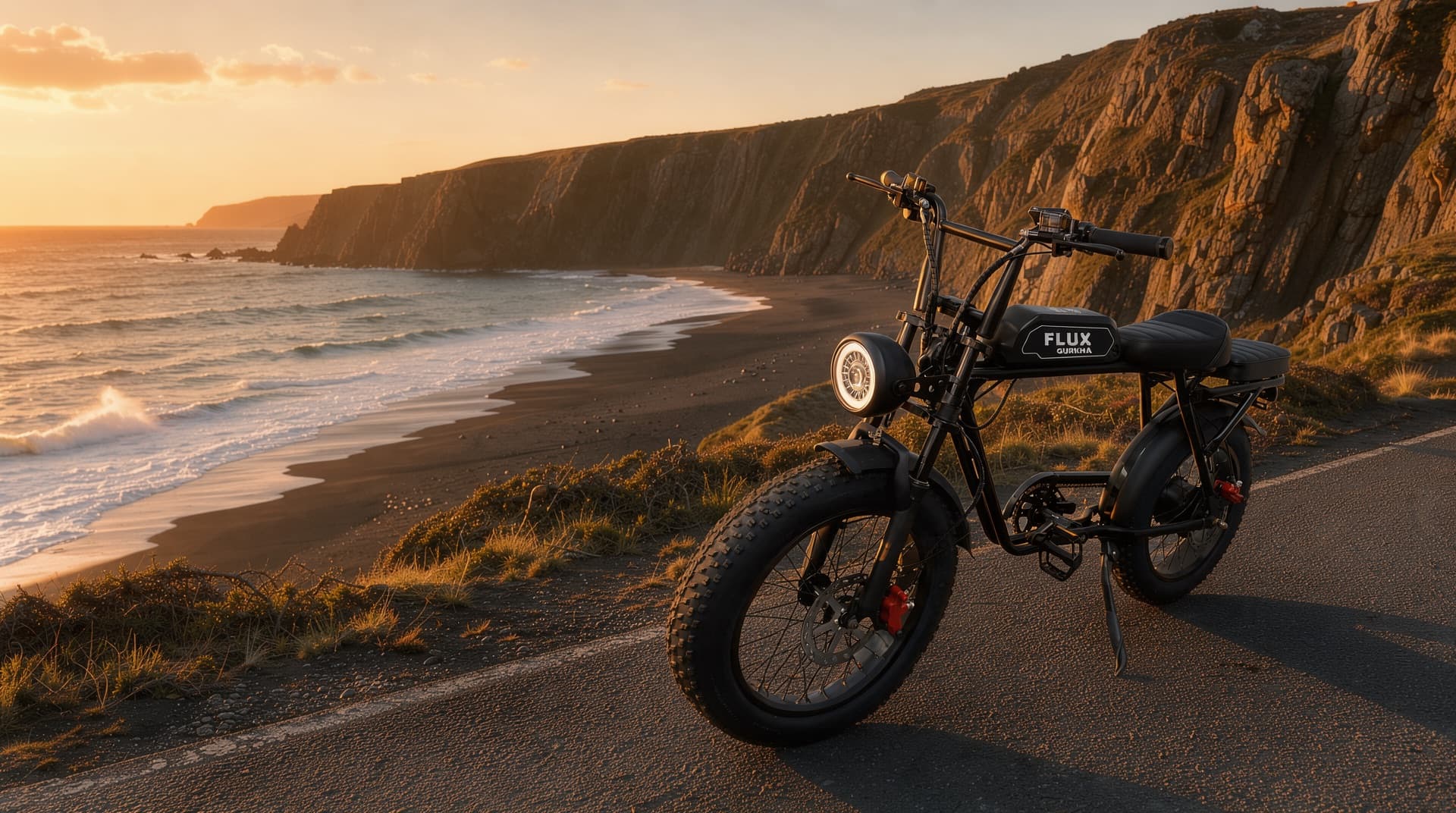
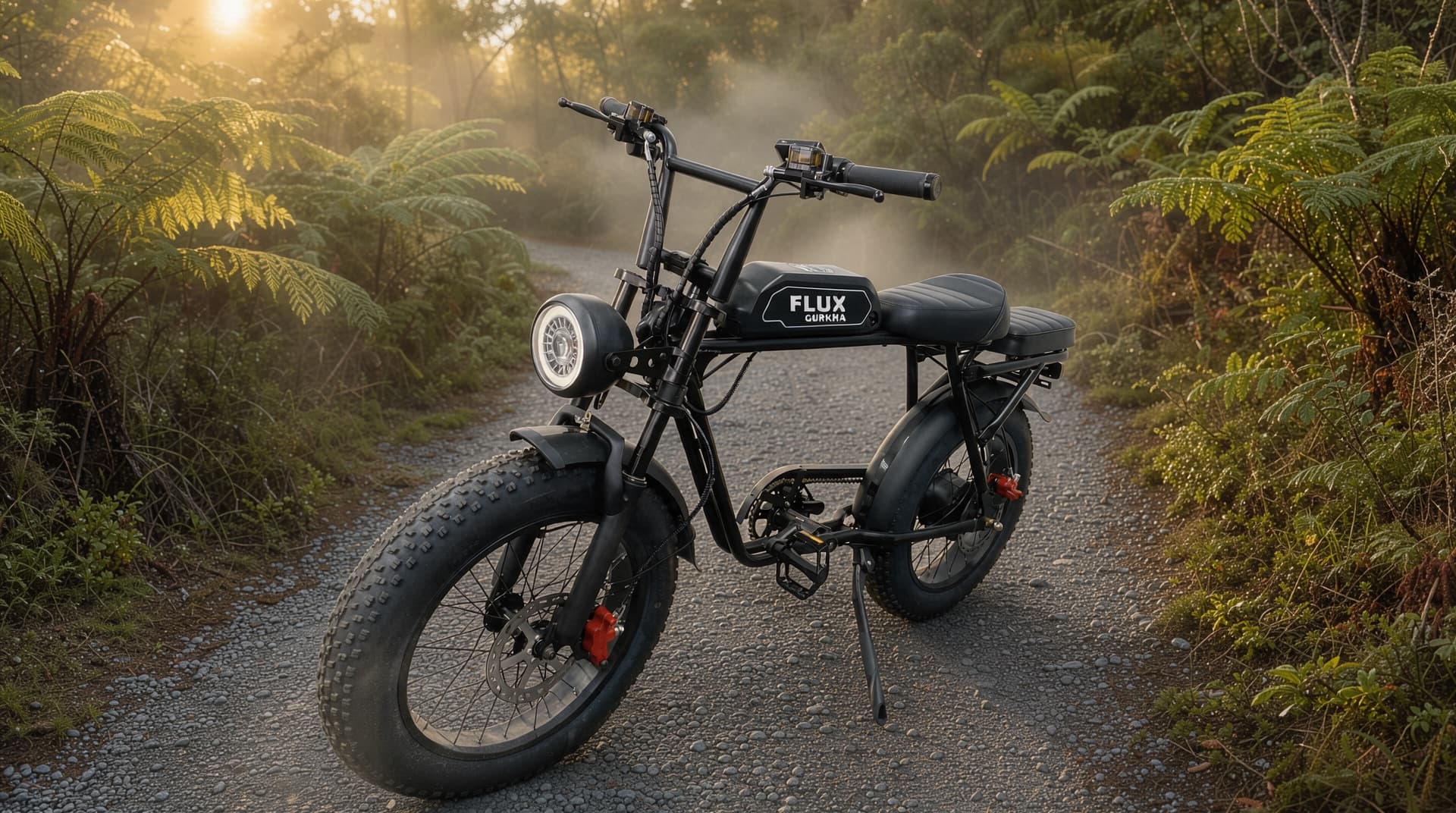
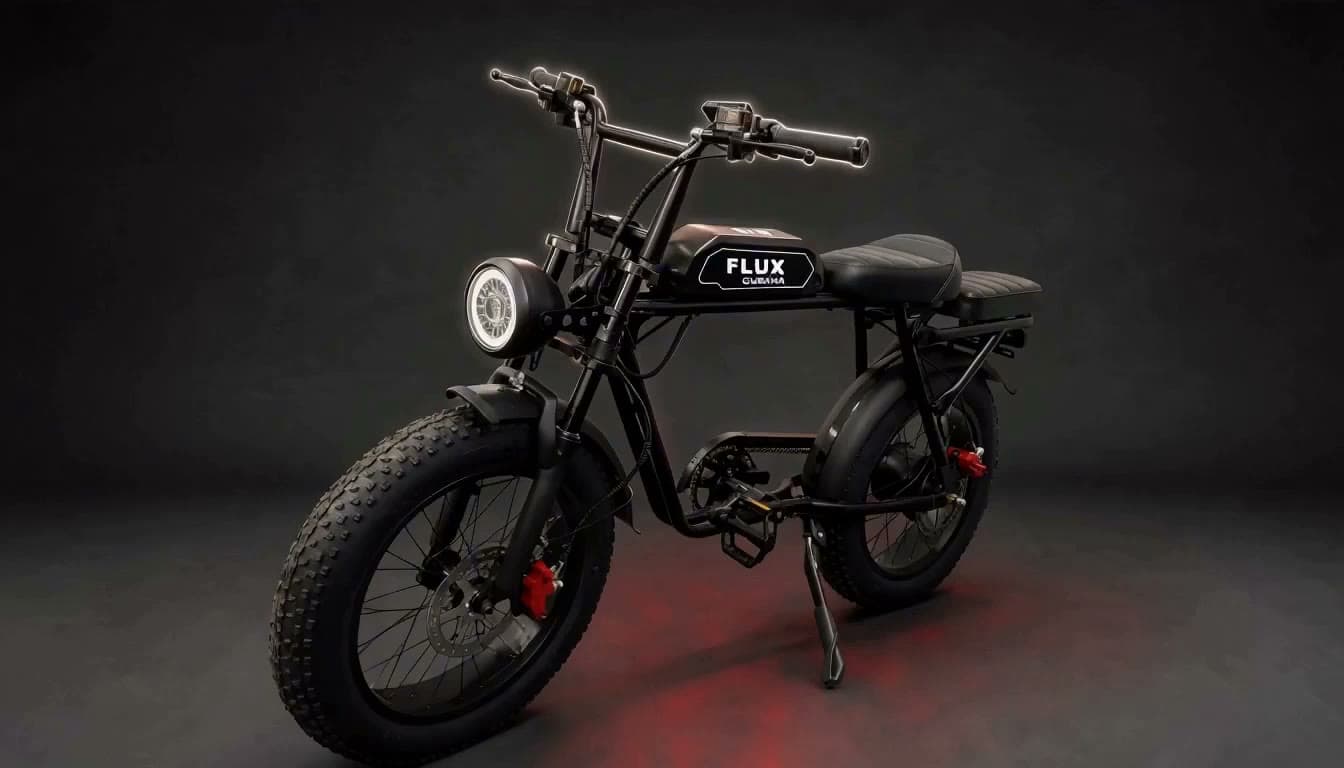
There is no single best e bike NZ riders should all buy, and we won't pretend otherwise. We designed the Gurkha in Aotearoa for riders who want something sturdier and more relaxed than a skinny commuter. It is a smart fat-tyre, moto-inspired e-bike with 20×4-inch tyres, a long bench seat, hydraulic disc brakes front and rear, a brushless rear hub motor, an aluminium alloy frame and a 624 Wh lithium-ion battery. Assisted top speed is 25 km/h, and Bluetooth with the Flux app lets you adjust settings, track rides and check the battery. It starts from NZ$4,499.
It is not on sale yet, and Flux will confirm full specifications before launch. If you want a featherweight road bike or a long-travel trail machine, it is not that bike, and we'd rather tell you now. If you want comfort and grip across town, gravel and the beach access road, it is worth a look. For more on mixed-surface riding, see riding an e-bike off-road.
Ready for what's next?
If the Gurkha sounds like your kind of bike, join the waitlist and we'll let you know first when full specs, pricing and delivery dates are confirmed.
Frequently asked questions
Do I need a licence or rego for an e-bike in NZ?
No. A power-assisted cycle with motors of 300 W or less combined is declared not to be a motor vehicle, so it needs no driver licence, registration or WoF. You still need an approved helmet on the road and lights at night.
What is the legal power limit for an e-bike in New Zealand?
The Road User Rule defines a power-assisted cycle as having auxiliary motors with a combined maximum power output not exceeding 300 W. A 2026 law change lets NZTA create categories up to 2,000 W, but as at November 2026 we could not find a declaration that changes the e-bike limit.
How much does it cost to charge an e-bike in NZ?
Very little. A 624 Wh battery holds about 0.62 kWh, so at an assumed 35 cents per kWh a full charge costs roughly 20 to 25 cents including charger losses.
Which type of e-bike is best for New Zealand?
It depends on your riding. Commuter e-bikes suit sealed roads and cycleways, e-MTBs suit trails, fat-tyre e-bikes suit gravel, sand and comfort, and cargo bikes suit family errands. Hilly areas benefit from strong brakes and good low-speed torque.
Is the Flux Gurkha available to buy now?
Not yet. The Gurkha is priced from NZ$4,499 and the waitlist is open. Flux will confirm full specifications before launch.